Wednesday, November 7, 2012

Movie Review: Wreck-It Ralph

Wreck-It Ralph
Directed by: Rich Moore.
Written by: Phil Johnston and Jennifer Lee.
Starring: John C. Reilly (Ralph), Sarah Silverman (Vanellope), Jack McBrayer (Felix), Jane Lynch (Calhoun), Adam Carolla (Wynnchel), Alan Tudyk (King Candy), Mindy Kaling (Taffyta Muttonfudge), Joe Lo Truglio (Markowski), Ed O'Neill (Mr. Litwak), Dennis Haysbert (General Hologram), Edie McClurg (Mary ).

Poor Ralph. For 30 years, he has had to be the bad guy in an arcade game, Fix-It Felix Jr., where his job is to try and destroy a building, before that do-gooder Fix It Felix Jr. himself, with a magic hammer, comes along, fixes the building, and save all the residents, who then give him pie and a medal, while they throw Ralph into the mud below. Even after the arcade closes for the day, the other characters in the game celebrate in their nice apartments, while Ralph retires to his home in the dump. One day he goes to a Bad Anon meeting, where all the bad guys from the arcade games gather to tell their stories – about how hard it is to be the bad guy. But hey, just because you’re a “bad guy”, doesn’t mean you’re a bad guy, right? All Ralph wants is to just once get a medal of his own. So Ralph does the unthinkable and game jumps. One day, instead of reporting for work in his game, he disguises himself as a soldier for the new game Hero’s Duty, so he can win a medal. He does, but botches the escape, and ends up, along with an evil Cy-Bug, in the candy colored girls racing game Sugar Rush, where he almost immediately makes an enemy, and then a friend, of Vanellope, a “glitch” who just wants to race like the rest of the girls. Of course, by game jumping, he has put his own game at risk of being unplugged – and by bringing a Cy-Bug along with him into Sugar Rush, he may have put the whole arcade at risk, so Fix-It Felix teams up with Calhoun, the main character from Hero’s Duty, to bring Ralph home, and stop the Cy-Bug.

Wreck-It Ralph may not be a Pixar film, but it operates on the same principles of a Pixar film – give the kids a lot of brightly colored action and humor, while sliding in sly in-jokes and nostalgia for their parents. There’s no mistake that I, who played a lot of video games as a teenager, but very few (other than the yearly installment of EA Sports’ NHL series) since then, could almost immediately identify almost all the “real” video game characters that Wreck-It Ralph has in it. While it’s clear that Hero’s Duty is modeled, at least somewhat, on Call of Duty, for the most part the real game characters the movie has could be found on your old Super Nintendo or Sega Genesis. The movie wants to get that nostalgic laughter from the parents in the audience – and it does a wonderful job of that. Wreck-It Ralph is not quite at the level of the best Pixar movies, but it’s much better than most of the movies made for kids these days.

I loved the animation of Wreck-It Ralph, which is almost endlessly inventive. The film, directed by Rich Moore, moves seamlessly between the different video games it takes place in, but I loved how the characters from different games moved differently, depending on when the game was made. The Nicelanders (the residents of the building Fix-It Felix is building) move with that choppy motion anyone who grew up with a Nintendo will immediately recognize. When we move into Hero’s Duty, it has the same sort of energy that the best first person shooters have. And the candy land created in Sugar Rush is almost endlessly inventive, and sprawling. The movie is a visual delight from beginning to end.

The filmmakers also cast the movie very well. Is there anyone who can sound more depressed, and yet still be lovable as John C. Reilly, who was perhaps the only choice to give Ralph his voice? Or anyone who sounds more like a goody-two shoes, innocent hero than Jack McBrayer, who is great as Fix-It Felix? Or any woman who sounds more convincing than Jane Lynch barking out orders as Calhoun? The real treat here though is Sarah Silverman as Vanellope, who may not have jumped to mind to play an a character this cute and lovable, even if she does have a mischievous side. But Silverman nails it, and makes Vanellope into perhaps the most lovable animated creation this year.

Yes, the movie devolves into the kind of loud, seemingly never ending climax with lots of action and noise, that can grow tiresome after a while, unless you’re a kid. Yet, there’s some much here to love, that I’ll forgive the film for taking the easy way out with its finale. Wreck-It Ralph is one of the better animated films you’ll see this year.

Tuesday, November 6, 2012

TV Movie Review: The Girl

The Girl
Directed by: Julian Jarrold.
Written by: Gwyneth Hughes based on the book by Donald Spoto.
Starring: Sienna Miller (Tippi Hedren), Toby Jones (Alfred Hitchcock), Penelope Wilton (Peggy Robertson), Imelda Staunton (Alma Hitchcock), Sean Cameron Michael (Robert Burks), Candice D'Arcy (Josephine Milton), Carl Beukes (Jim Brown).

I’m not going to try and argue that Alfred Hitchcock was a saint – or that he didn’t sexually harass actress Tippi Hendren in a way that no one would get away with anymore. The stories of his obsessions with his blonde leading ladies are legendary, and have been explored at length in a number of books. Even in a largely glowing book like Alfred Hitchcock and the Making of Psycho by Stephen Rebello, it doesn’t take too much reading between the lines to know that Hitchcock’s relationship with actress Vera Miles most likely crossed a line in terms of Hitchcock’s behavior towards her and her career. What I am going to argue however is that I don’t believe it’s quite as simplistic as the new HBO film The Girl makes it out to be. In this film, Hitchcock makes a sexual advance at Hendren before the shooting of The Birds, she rejects him, and he spends the next two years, over the course of shooting The Birds and then Marnie, torturing her on set, before refusing to let her out of her contract, and essentially stalling, if not ruining, her acting career – which he gave the model turned actress to begin with by casting her in The Birds, even though she had no movie experience. Hitchcock may well have been a perverted asshole – but I don’t think it was all as simple as this movie makes it to be.

The Girl contains three very good performances – much better than the movie itself deserves. As Tippi Hendren herself, Sienna Miller is very good. At first she idolizes Hitchcock – is extremely grateful him offering her the chance to star in one of his movies. She lets herself be guided by Hitchcock – he knows what he wants from her onscreen, and she doesn’t have a clue. She quite likes his Hitchcock’s wife, Alma, as well. She sees them as a quietly dignified British couple. After the sexual advance and the rejection, she becomes defiant – knowing that Hitch is torturing her, but not wanting him to see her as weak, so she withstands everything that he can throw at her. The best thing about Miller’s performance may be how accurately she is able to get the look Hendren has in her eyes during key scenes in The Birds and Marnie – where Hendren truly is great in both movies. The second great performance is by Imelda Staunton as Alma Hitchcock. I don’t think you can argue that the movie accurately portrays her relationship with Hitchcock – who adored her, and valued her as a collaborator on his movies (as the upcoming movie Hitchcock apparently shows), but Staunton is great as a woman who fears losing her husband, so she lets him get away with whatever he wants.

The best performance however belongs to Toby Jones as Hitchcock himself. Jones had the misfortune of giving a very good performance as Truman Capote in Infamous – released just a year after Philip Seymour Hoffman won as Oscar for playing the same role in Capote. He may well be dismissed again, since Anthony Hopkins will play Hitchcock in just a month in Hitchcock – which is getting a theatrical release. But that shouldn’t detract from how well Jones does as Hitchcock – nailing the voice, the mannerisms, and trying his best to make Hitchcock into a complicated character, while the movie spends more time trying to pass him off as a pervert torturing the heroic Hendren. Jones is brilliant in the movie – I just wish the movie could match his performance. If there’s one thing Hitchcock always did well in his best movies, it’s that he made the villain a complex character – think Claude Rains in Notorious or Anthony Perkins in Psycho, or hell, Sean Connery in Marnie. Hitch would never give this much screen time to a one dimensional villain.

Hitchcock may well have been hard on Hendren during the shooting of these two movies – but then again, he was notoriously hard on all of his actors. He had the movie he wanted in his head before he shot a frame of footage, and he did what he needed to do to get what was in his head on the screen. And you can say anything you want about Hitchcock, but he got two great performances out of Hendren – better than she did in the rest of her career. I have no trouble believing that Alfred Hitchcock was a pervert – have you seen Vertigo or Marnie to name but two of his films that deal with sexuality – and he may well have been a complete asshole to Hendren on the set of their two movies together. I just wish that The Girl had any sort of complexity to it at all. Instead, it paints Hendren as a one dimensional heroine as Hitchcock as a one dimensional villain. Both of them deserve a more complex movie to tell their shared story.

Movie Review: Flight

Flight
Directed by: Robert Zemeckis.
Written by: John Gatins.
Starring: Denzel Washington (Whip Whitaker), Kelly Reilly (Nicole), Bruce Greenwood (Charlie Anderson), John Goodman (Harling Mays), Don Cheadle (Hugh Lang), Melissa Leo (Ellen Block), Nadine Velazquez (Katerina Marquez), Tamara Tunie (Margaret Thomason), Brian Geraghty (Ken Evans), Garcelle Beauvais (Deana), Justin Martin (Will).

Denzel Washington delivers one of his very best performances in Flight. Like the recent indie film Smashed, Flight is about an alcoholic who finally hits bottom. But Smashed was a stripped down film – about nothing else other than the main characters struggle with sobriety – whereas Flight is about a lot more than that. It has a complicated plot that requires Washington to hit some very difficult notes. His character is at turn’s drunk, arrogant, in denial, depressed, jovial and over all, is pretty much a selfish jerk for most of the running time of Flight. And yet, Washington never loses our sympathy. His character is placed in a situation in which there are no good options open to him, and who eventually has to make a decision that no matter what he chooses, will not really benefit anyone. More often than not, I prefer the stripped to the down indie over the Hollywood version of the same story – not this time though. Flight is one of the best films of the year – and the rare film that finds new territory to explore in the world of alcoholics. Washington’s performance elevates the entire movie – and the entire supporting cast around him.

Flight opens with a scene that is familiar to all drunks – waking up in the morning, still a little bit drunk from the night before, unsure of what happened, and needing a “pick-me-up” to start the day. Washington’s Whip Whitaker gets this pick-me-up in the form of stale beer and cocaine before heading to work. This would be bad enough no matter what his job was – but since he’s an airline pilot, who has a flight at 9 that morning, it’s even worse. But Whip is a high functioning alcoholic – he knows what he’s doing, and the flight is a short one – Orlando to Atlanta – so even though the weather is bad, he can do this one in his sleep – which after a rough take off, due to weather, is exactly what he does. But late in the flight, things start going horribly wrong. They lose control of the plane and start a nose dive.

What follows is perhaps the most intense plane crash I have ever seen on film. This is where director Robert Zemeckis – making his first live action film after more than a decade making motion capture animation films – really shines. The crash is terrifying, and told in minute by minute detail, as we see everything that happens. This is probably as close as you’re likely to get in terms of experiencing what a plane crash is really like while watching a movie. Miraculously, almost everyone on the plane survives – only 6 deaths out of 102 people on board. When they put other pilots through a simulation to determine if anything could have been done differently by the pilots, not one of them was able to save a single person. But none of that actually matters in the case of Whitaker. They take his blood while he’s unconscious in the hospital – and it shows the alcohol and cocaine in his system. If he’s lucky, he’ll get off with just a few years in jail for flying while intoxicated – if he’s unlucky, he’ll go to jail for life on six counts of manslaughter.

The crash itself is easily the most memorable sequence in Flight – and the most brilliantly directed by Zemeckis. But it’s also only a small part of what makes Flight such a good movie. Most of the movie is about Whip dealing with his alcoholism – mostly by not dealing with it and drinking himself into a stupor day after day, all while trying to avoid the press, and having meetings with his union rep (Bruce Greenwood), who wants to see Whip cleared of any wrongdoing, because it would make the union look bad otherwise, and his lawyer (Don Cheadle), who wants to get him off, because, well, that’s what he is paid for. For a while, Whip gets involved with Nicole (Kelly Reilly), a recovering drug addict he met while in the hospital. For a while, she needs him the same way he needs her – but as she starts putting the pieces of her shattered life together, she realizes that Whip maybe beyond redemption – and if she stays, she may be as well. Washington is brilliant in the movie, and it’s to Reilly’s credit that she matches him in their scenes together. The two characters act as a mirror for each other – to Nicole, Whip is what she doesn’t want to be anymore. With Whip it’s more complicated than that – he knows Nicole has a problem, but he cannot bring himself to admit that he has one. Eventually Nicole will be just another person he has pushed away – like his ex-wife and son, who he lost because of his drinking before the movie even starts. The only person who truly seems to like Whip is Harling Mays (John Goodman) – and that’s because he’s his drug dealer. In just a few short scenes, Goodman leaves a lasting impression on this movie. If Reilly is the angel on Whip’s shoulder trying to convince him to be good, than Goodman is the devil on the other, trying to draw him back to the dark side.

I have seen a lot of movies about drunks over the years – so many in fact that I had begun to feel as if there was little new one could do with the material. While Flight certainly hits the notes that many movies about drunks do, it feels fresh and original – partly because the plot is more complicated than most – the implications of Whip’s alcoholism are not limited to himself, and partly because Washington is so good in the movie. This type of role is like a high wire act for an actor – just how far can he push the audience away, and still have them rooting for his recovery. Flight belongs on a list with films like Billy Wilder’s The Lost Weekend (1945) and Mike Figgis’ Leaving Las Vegas (1995) - and that's good company to be in.

Movie Review: This Must Be the Place

This Must Be the Place
Directed by: Paolo Sorrentino.
Written by: Umberto Contarello & Paolo Sorrentino.
Starring: Sean Penn (Cheyenne), Frances McDormand (Jane), Judd Hirsch (Mordecai Midler), Eve Hewson (Mary), Kerry Condon (Rachel), Harry Dean Stanton (Robert Plath), Joyce Van Patten (Dorothy Shore), David Byrne (Himself), Olwen Fouere (Mary's Mother), Shea Whigham (Ernie Ray), Liron Levo (Richard), Simon Delaney (Jeffery), Heinz Lieven,  (Aloise Lange), Sam Keeley (Desmond), Gordon Michaels (Tattoo Mike).

Paolo Sorrentino’s This Must Be the Place is inarguably one of the strangest films you will see this year. When the film begins, you would never guess that it would end up where it does – it just seems so far out there. And yet, somehow the film works. I disliked the film for the first half hour or so, but gradually, it won me over.

The movie opens in Ireland where Cheyenne (Sean Penn), a retired, Robert Smith-type 1980s glam rocker lives out his quiet retirement in a modern mansion, with his normal, firefighter wife Jane (Frances McDormand). He is bored, and spends his days hanging out with a sad young woman, Mary (Eve Hewson) hanging out at the mall, and cooking frozen pizza in his modern kitchen. On more than one occasion, people tell him he’s like an overgrown child – he was never forced to grow up, so he never did. He’s soft spoken and innocent – he even asks some of those seemingly simple, yet ultimately unanswerable questions children seem to specialize in.

Things change though when his father gets sick, and he has to travel back to America for the first time in decades – he doesn’t fly, so he has to take a boat, and he arrives too late, and his father is dead. He decided when he was 15 years old that his father – a Holocaust survivor – never loved him, and although he responded by not talking to his father, he never really got over it. When he finds out that his father spent his entire life trying to track down Aloise Lang – his tormenter at Auschwitz, and got so far as finding his American wife. Cheyenne decides to go on a cross country journey – in a pickup truck – to try and finish what his father started.

The early scenes in the movie bugged me. Watching Cheyenne live out his boring life in the lap of luxury, but still be unfulfilled, just didn’t interest me very much. Penn, buried underneath makeup and huge hair, and hiding behind his small, childlike voice, also grated on my nerves at first. These early scenes just didn’t really work for me when they were playing – yet they are crucial in retrospect. Without them, you won`t realize just how far Cheyenne comes during the course of the movie.

After his father dies, and the cross country journey begins however, This Must Be the Place really settles into a groove, and becomes an oddly compelling movie. The film reminded me of the strange, American cross country journeys by Wim Wenders – like his masterful Paris, Texas (which I think is why the film casts Harry Dean Stanton in a cameo role) or his underrated Don’t Come Knocking. While Wenders films were set in America, as a German filmmaker, they had a European feel to them – they looked at America in a way that American filmmakers simply do not. Italian filmmaker Sorrentino does the same thing here – but with a touch of strange, Lynchian surrealism thrown into the mix. The film doesn’t have the masterly control of Sorrentino’s last film – the brilliant Il Divo (not about the opera group) – but it is still a fascinating movie from beginning to end. It is a film about fathers and sons – and how you can never really escape that shadow, or never stop striving to make him proud. While Penn’s performance is strange, it is also effective as it moves along. By the end of the movie, I was surprised by how moved I was by his story – especially after how little I cared about it when the film began.

Thursday, November 1, 2012

Denzel Washington's Top 10 Performances

With Flight being released this week, I figured I’d look back at the 10 best performances by Denzel Washington. Washington is undeniably a great actor, and he can almost always be counted on to deliver a good performance – no matter how bad the movie itself is (John Q., Fallen, The Bone Collector, The Pelican Brief, etc). He elevates nearly every movie he’s in. As you will see from the list, I am certainly a fan of his work with Spike Lee – but Washington has been great in any number of movies. The buzz suggests he’s a lock for another Oscar nomination for Flight – it would be his sixth nomination, although he has not been nominated since the last time he won in 2001.

10. The Manchurian Candidate (Jonathan Demme, 2004)
John Frankenheimer’s 1962 original version of The Manchurian Candidate is one of the greatest, paranoid, political thrillers ever made – and although fewer people noticed, Jonathan Demme does it justice in his 2004 remake. No, it’s not the masterpiece the first film was, but it is still a top notch thriller, updated brilliantly (no commies this time, just the Manchurian Corporation, buying and selling politicians). Meryl Streep delivered one of her best recent performances as the stage mother from hell, and she stole most of the praise for the film. And yet Washington, who we are used to seeing as an action star, does something different in this film – he makes his Ben Marco into a jittery, paranoid bordering on insane man, haunted by nightmares and his own demons. It was easier to accept Frank Sinatra knew the truth – harder to picture Washington in this film knowing anything – he literally seems crazy. Washington doesn’t hold back, he goes right at the role, and he is one of the reasons it works so damn well. An under rated performance to be sure.

9. Cry Freedom (Richard Attenborough, 1988)
Most people have probably forgotten all about Richard Attenborough’s Cry Freedom in the 24 years since the film was released – and there’s a reason for that. Here is the story of Steve Biko, a South African leader who fought against Apartheid told entirely from the point of view of a white liberal (Kevin Kline), who befriends him, and when Biko is murdered at the halfway point of the movie, the film switches to Kline’s efforts to get out of Africa so he can publish the book Biko has written. Telling Biko’s story this way allows Attenborough to have a false happy ending – Kline getting to freedom – instead of an authentic sad one – Biko’s murder at the hands of the police. So why then is this film on the list? Because Washington in that first half of the film is brilliant as Biko – so much so that we wish the movie were actually about him, his life and his work, and not about the brave white guy who visited him a few times and smuggled his book out. Had the movie actually been about Biko – and had allowed Washington a chance to play him from beginning to end, the movie could have been great. Now, the only reason to watch it is to see a young, brilliant Washington at the height of his powers. Pity.

8. Devil in a Blue Dress (Carl Franklin, 1995)
Carl Franklin made his debut film, One False Move, in 1992, the same year Quentin Tarantino made Reservoir Dogs, and if you look at the year-end critics’ awards, it was Franklin and not Tarantino who won most of the “Breakthrough Director” Awards. Sadly, Franklin has become merely a footnote in cinema history, and that’s too bad because One False Move is one of the best crime dramas of the 1990s, and his follow-up film, Devil in a Blue Dress, is a nifty little, almost all black film noir – featuring Washington at his best as P.I. East Rawlins (not to mention giving Don Cheadle his breakout role as the insane killer Mouse). The period details of L.A. in 1948 – and not the L.A. of 1948 we normally see, but the black L.A. – are amazingly well done. Washington fits nicely into the mold of noir detectives like Sam Spade and Phillip Marlowe. Washington knows he’s playing an archetype – but he does it so well. An underrated gem.

7. Philadelphia (Jonathan Demme, 1993)
Tom Hanks may have won an Oscar for Philadelphia, but I’ve always thought that Washington had the more difficult, complex role. Yes, I am impressed with Hanks, and the makeup team behind the movie, as he slowly wastes away from AIDS, but it is Washington as his lawyer – who starts off more than a little homophobic, but gradually learns to respect, and even love his client, that really transforms through the course of the movie. The film is almost more about his journey than Hanks’ – and Washington nails the role. Yes, I think it’s a shame that the first time Hollywood really decided to tackle the AIDS issue, they had to shoehorn it into a genre they understand – the courtroom drama – but that doesn’t detract from Washington’s excellent performance.

6. The Hurricane (Norman Jewison, 1999)
Norman Jewison’s movie, about Ruben “Hurricane” Carter, the boxer falsely convicted of murder in the late 1960s and spend more than 2 decades in jail has its fair share of problems – but none of them involve Washington’s performance as the man himself. Carter is understandably cynical and not very hopeful that the people who tell him they’re going to get him out of jail are going to be able to succeed where everyone else has failed – he is certainly not a warm and cuddly character. But he imbues Carter with dignity and righteous anger. And he carries the movie.

5. Inside Man (Spike Lee, 2006)
Inside Man is perhaps the most underrated film of Spike Lee’s career. It was a box office hit, and most critics praised the film as being an excellent example of its genre – the heist thriller. But Lee could not resist putting his own spin on the material – and inside this genre film, Lee makes some comments on morality, money, greed and race – themes that have obsessed him in recent years. And it is also an underrated performance by Washington – as a cop under investigation for stealing money, who gets put in the middle of a hostage situation, in which some of the very issues he is dealing with in his Internal Affairs investigation come up. Washington is in movie star mode here to be sure, but there are subtleties to this performance that were missed by many – perhaps most especially at the films end. Did anyone else notice that the case against him was dropped, but at no time is it said that he is innocent?

4. Glory (Edward Zwick, 1989)
I have a few problems with Edward Zwick’s Glory – the biggest being that it is a film about an “all black” platoon of soldiers fighting for the Union in the Civil War, and yet is told from the point of view of the white commanding officers. Overall however, this is an excellent Civil War film – and one of the reasons why is Washington’s excellent Oscar winning performance as Trip, an understandably bitter and angry escaped slave, who tells his white commanding officer he is not fighting for them, but for himself – for his freedom. Washington has that righteous anger he does so well, but during the course of the movie, he also evolves – becoming a natural leader among the men in the company – and his final scene, as clichéd as it is, will bring a tear to your eye. Washington was a great actor before Glory, but it confirmed he was here to stay – and remains one of his best performances.

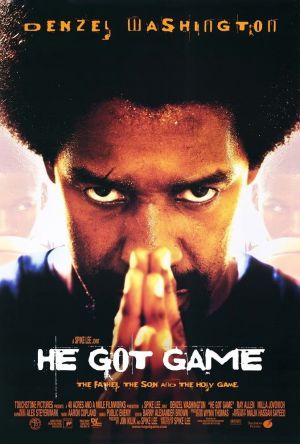
3. He Got Game (Spike Lee, 1998)
He Got Game is one of the best sports movies ever made – perhaps because it only uses sports as a backdrop for it’s bigger story that of a complex father-son relationship at the film’s core. Washington plays Jake, a man in prison for manslaughter because he killed his wife (although it isn’t as simple as it sounds), who has been let out of jail for one week by the Governor of his state. Why? Because Jake’s son is the best high school basketball player in the country, and the Governor wants him to go to his alma mater – if Jake can get him to sign his letter of intent there, the Governor will reduce his sentence. Now, I doubt this would actually happen, but it isn’t too far off the mark – college sports is big business in the States, where everyone except the athletes make money. But Lee’s film is smart enough to know the reality behind recruitment. But mainly, he uses this as his backdrop for this father-son movie – the son hates his father, which Jake understands, but gradually, the two at least start to understand each other – and while the son may not grow to love his father, he does begin to see him as more than just a monster. Washington’s performance here is subtle – not his standard bombast, but with an undercurrent of sadness and regret. It’s one of Lee’s best films – and one of Washington’s very best performances.

2. Training Day (Antoine Fuqua, 2001)
Washington has played a lot of heroic characters – or at least characters with a strong moral fiber – but I think he’s even better playing villains. Washington won his second Oscar for this wildly over the top performance as one of the most corrupt cops in movie history. From his opening scenes, where he takes rookie narc Ethan Hawke around L.A., we know he’s up to no good, even if Hawke doesn’t quite suspect it. From there, he only gets worse and worse, climaxing in a wonderful death scene. Washington lets it all hang out in Training Day – he goes for broke, not worrying about subtlety – and that is precisely what makes this performance so good. The movie itself is only pretty good – a violent, entertaining cop movie that doesn’t really add much to the genre, and so it needed a performance as magnetic, corrupt, funny and over the top as Washington’s to make the movie stand out. And Washington delivers.

1. Malcolm X (Spike Lee, 1992)
Washington’s performance in Malcolm X is not only his finest performance – it’s one of the finest performances in screen history. The movie follows Malcolm X from his days as a street hustler, through his prison sentence, to his conversion to Islam to becoming one of the most influential leaders of the 1960s, to his slow softening that led to his death. Washington nails the cadence of Malcolm X’s voice and mannerisms, but his performance goes well beyond mere impersonation and gets to the heart of Malcolm X – contradictions and all. Spike Lee’s film is one of the best screen biographies of all time, and a large reason for that is Washington’s excellent performance. The fact that he didn’t win an Oscar for this performance was one of the biggest mistakes in Oscar history.

Movie Review: The Invisible War

The Invisible War
Directed by: Kirby Dick.

If you’re a woman who joins the United States military, you are far more likely to be raped than if you didn’t sign up. Not only that, but until recently, the person who decided whether or not an investigation was warranted when someone brought up sexual assault allegations was your unit commander, and according to the stats used by The Invisible War, 25% of women who didn’t report that they were raped didn’t do so because the person who they have to report to, is the person who raped them. Another 30% didn’t report it because the person they have to report to is friends with the person they are accusing. A group of military rape survivors recently had their lawsuit against the government thrown out – essentially because the court ruled that being raped was an occupational hazard of being in the military.

Kirby Dick’s The Invisible War is full of shocking facts like this – all of them which come from the U.S. government itself, including the fact that it is estimated that 22,000 rapes occurred in the military last year, only 3,000 were reported and only 100 led to convictions with any jail time – most of the time, less than 1 year. Some rapists had their ranks reduced though or had other such disciplinary action taken against them.

Dick flashes this statistics up throughout the movie, but wisely, he concentrates on the survivors, who tell their stories to Dick himself. It cannot be easy for these women – and one man – reliving the worst moment of their lives, but they do it because they want things to change. Many of them have the same basic story – of being patriotic and idealistic upon entering the military, only to be raped once they got there. Almost to a person, they part they feel was even worse was the treatment they received when they reported the rapes – nothing was done, and sometimes they even found themselves court martialed for adultery (even though they weren’t married, their rapist was, although they don’t get court martialed) or filing a false claim. They are told repeatedly that they were “asking for it”. One woman is told that she shouldn’t have gone out drinking with the men – although it was understood to be part of their job. Another is told she was dressed proactively, even though she was wearing her official dress uniform, which includes a skirt. The military has known this is a problem for years, but has merely paid it lip service – including ridiculous videos and posters shown to the recruits, one of which offensively advises men to play it safe – wait until she’s sober. This ad campaign also includes helpful hints like using the buddy system, as if being in the military is akin to walking home from elementary school.

The most heartbreaking story in the movie is Kori Cioca, who was raped when she was in the Coast Guard, and had her jaw broken by her attacker. She needs surgery to get it repaired, but the government is refusing to pay for it – she wasn’t in the Coast Guard long enough (she’s short by two months); although the injuries sustained in the rape were the reason she left. Five years later, she’s still on a soft diet, and battling her way through government bureaucracy.

The movie has already led to some changes, although the military won’t acknowledge it was the film that made it changed, but when Defense Secretary Leon Panetta watches the film, and then two days later decides to take the charging authority away from unit commanders, it’s impossible to deny the two are unrelated. This is not an easy film to watch, but it is an essential film – one that has already inspired some change, but demands that more changes come. This is an important documentary.

Movie Review: We Are Legion

We Are Legion
Directed by: Brian Knappenberger.

Anonymous is an internet collective, with no leadership, that has become a force online. What started out on websites like 4chan, where a bunch of people posted strange, sick, deranged and often hilarious pictures in an attempt to one up each other, has turned into a very real movement – that is responsible for some good and some bad online. Because there is no real leadership, essentially anyone can be part of Anonymous, and they can do anything they want. Some people in the movement are, to put it bluntly, dicks – yet some are idealists, who are doing what they do for the right reasons, even if that means breaking the law.

We Are Legion is a fascinating documentary, perhaps a bit too slanted in favor of Anonymous, but mostly plays fair, that tracks this organization’s development from a group of people just trying to amuse themselves, to a group who sees themselves as a force for good. Whether it’s taking on racist radio talk show host, and essentially ruining his life (but who the hell is going to feel sorry for him), to going to all-out war with Scientology, when they tried to block Tom Cruise’s promotional video from being available online, to attacking Paypal, Visa and Mastercard when they stopped letting you donate to Wikileaks using those methods (although they apparently have no problem with you donating to the KKK that way) to helping those in Egypt during the protests still be able to get online and let the world know what was going on, you may not agree with everything Anonymous does, but for the most part, their hearts are in the right place – and they are willing to stand up for what they believe in. The assholes you thought Anonymous was getting too serious, and so hacked the epilepsy site to make it flash bright lights on and off though are just jerks. And the offshoot group LulzSec, who were not just targeting corporations, but harming innocent bystanders, are also near impossible to defend.

We Are Legion is hardly a great documentary, but it remains a fascinating and insightful one. Pinning down a group like Anonymous is pretty much impossible – they have no leadership, no official spokesperson, and many of them refuse to show their own faces or reveal their own identity, preferring instead to hide behind Guy Fawkes masks – in part to protect themselves from prosecution, and in part because they feel they are more powerful if they cannot be identified as individuals.

But what We Are Legion does do, better than anything else I’ve seen anyway, is show you how Anonymous became what it is today, and how it continues to evolve, fracture and move forward. With so much of our lives happening online now, cyber activism or hacktivism as they call it will only grow in the coming years. What form that takes is anyone’s guess, but it is important to show how it got this far.